The Rescue
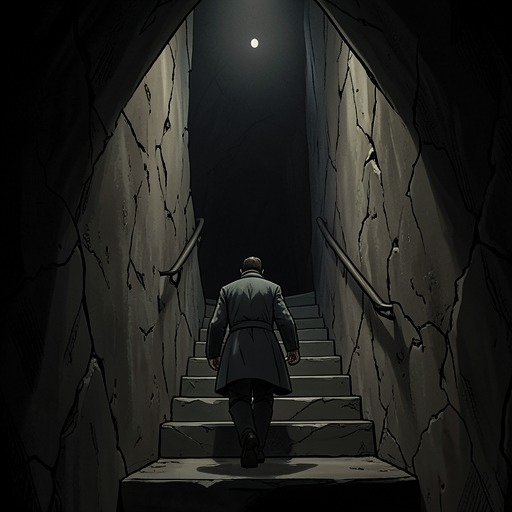
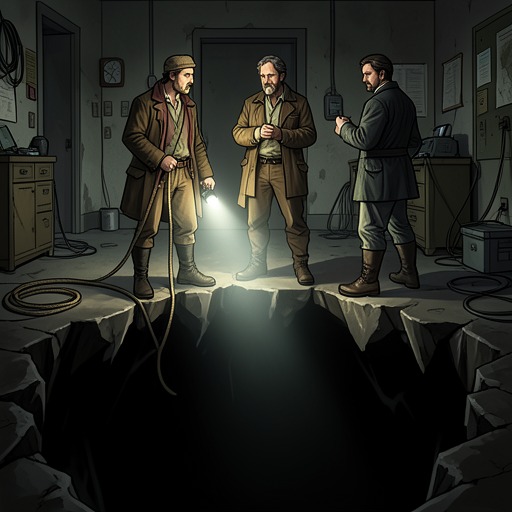
House of LeavesThe Rescue is the decisive descent into the labyrinth beneath the house on Ash Tree Lane, where Will Navidson and Billy Reston exchange ordinary exploration for an improvised recovery mission. What begins with a barely audible cry develops into a sequence of pursuit, discovery, sudden death, and bodily endurance: Jed Leeder is located behind an inexplicably locked door, rescued from apparent extinction, and then shot before relief can become safety, while Kirby “Wax” Hook is recovered alive but gravely injured. The event exposes the house as a space that defeats mapping, distance, and conventional rescue logic, yet it also makes solidarity concrete through the men’s labor to carry the wounded back toward the stairs.
Causes and Descent
The immediate cause of the rescue is a sound heard during the second night of Navidson and Reston’s stay inside the labyrinth. They had spent the day pushing deeper, first following the scant traces left by Holloway Roberts’s team and then relying on instinct. The near disappearance of the earlier expedition’s neon markers and fishing line leads Navidson to estimate that such guides survive no more than six days before being consumed by the house. Their own position is therefore unstable from the beginning: even a marked route is temporary, and the explorers cannot assume that a path preserved on one day will remain available on the next.
As the two men prepare their second camp, Navidson hears what may be a voice or a cry. The sound is so brief that it could have been dismissed as imagination, but Reston confirms it. They abandon most of their equipment and set off in pursuit. For forty minutes the labyrinth gives them nothing; then another distant cry renews the search. Three more hours pass as they move through rooms and corridors, marking their course with neon arrows and generous lengths of fishing line. The markers impose a fragile human order on a structure that repeatedly destroys continuity, while the cry supplies the only direction the architecture will allow.
The rescue is further complicated when Navidson reaches Tom Navidson by radio and learns that something is wrong with Karen Green, though the signal decays before he can receive details. The men must therefore pursue the hidden voice while knowing that danger may also be unfolding above them. Reston eventually identifies a wall as the source of the crying, insisting, “How we get through it, I don’t have a clue. But that crying’s coming from the other side.” The statement captures the event’s central contradiction: the location of the endangered person can be perceived, but ordinary access to that location remains impossible.
The Door and the Discovery
Navidson leads Reston through further corridors and turns until they reach a narrow passage ending in a door. Beyond it lies another corridor and another door. They proceed through a gauntlet of nearly fifty doors, although jump cuts make the exact number impossible to calculate. The repetition turns progress into a paradox: every apparent threshold merely reproduces the same obstacle, and movement forward resembles a multiplication of confinement rather than an escape from it.
The final door is unlike the others. It has no doorknob, yet it is locked. When Navidson pulls back to inspect the obstruction, he hears a whimper from the other side. He throws his shoulder against the door repeatedly. The first impacts bend it without opening it; only the fourth blow tears the hinges free, dislodges whatever bolt holds it, and sends the door crashing to the floor. Physical force succeeds where navigation has failed, but the victory is narrow and delayed, achieved only after the labyrinth has converted a simple entrance into a prolonged trial.
Reston keeps the mounted Arriflex trained on Navidson. The focus is slightly soft, and the sequence is assembled from unstable views supplied by Jed’s Hi 8 footage, the 16mm camera, and the explorers’ own Hi 8 cameras. Through that fractured record, Jed Leeder’s ashen face appears as if he were meeting his final moment. Instead, the contact produces an abrupt emotional reversal: his rasp of terror becomes laughter and sobs of relief. The thirty-three-year-old man from Vineland, New Jersey, who loves Seattle coffee and Lyle Lovett, learns that the sentence he expected to receive has been remitted. For an instant, the rescue seems complete. He will live.
Reversal and Death
The apparent rescue is overturned almost immediately. Frame-by-frame examination of the footage shows a bullet piercing Jed’s upper lip, blasting through the maxillary bone, dislodging and fragmenting his central teeth, and then obliterating the back of his head. The film preserves the sequence in enough detail to suggest that trajectories and fragments might be tracked, but not enough to reassemble what has been shattered. The event’s violence is therefore presented as both hyper-visible and irrecoverable: the cameras record the destruction precisely while making restoration impossible.
Jed crumples on the floor, his moment of joy stolen by a small piece of lead, as a black pool of blood spreads from him. The rescue’s value shift is instantaneous. Life returns as a possibility and is then withdrawn; recognition becomes catastrophe. The sequence refuses the consolations of a stable heroic pattern in which the endangered person is recovered and the danger ends. Here, the threshold opens onto safety only long enough for safety to be destroyed.
Navidson drags Wax and Jed out of harm’s way while trying to contact Tom by radio. Reston returns fire with an HK .45, revealing that he has brought a gun without Navidson’s prior knowledge. The practical rescue mission thus becomes an armed extraction under fire, and the men must distinguish between the dead and the living while remaining exposed to whatever threat has produced the shooting. Navidson recognizes that Jed is dead, but the needs of the living immediately claim his attention.
Carrying the Living Out
Despite a shoulder wound and substantial blood loss, Wax remains alive. Fever, probably associated with the onset of infection, has driven him into delirium. His rescuers are physically near, but his eyes remain fixed on an empty horizon, suggesting how far injury and the labyrinth have separated him from ordinary awareness. The footage lingers on Wax longer than on Jed, creating a grim contrast between the dead man’s brief final image and the prolonged fragility of the survivor.
At a later location, Navidson elevates Wax’s legs, cleans the wound, and gives him half a tablet of a painkiller probably identified as meperidine. The treatment is improvised and limited, but it marks a change from combat to care. Reston converts their two-man tent into a makeshift stretcher, arranging the poles to provide support and using pack straps to form two handles so Navidson can carry the rear end more easily. The equipment originally intended to sustain exploration is repurposed to sustain a wounded body.
Reston asks what will happen to Jed. Navidson answers that they will leave Jed’s pack and his own behind, accepting that the dead cannot be carried with them and that survival requires abandoning weight. Reston’s remark about old habits receives Navidson’s reply, “Or they don’t die,” a line that connects the immediate decision to Navidson’s history and gives the practical retreat an undertone of memory. Shortly afterward, Navidson contacts Tom and tells him to meet them at the bottom of the stairs. The rescue consequently ends not with triumph but with a coordinated attempt to bring Wax back through the same impossible descent that trapped him.
Meaning and Aftermath
The labyrinth gives the rescue a mythic structure without allowing it to become a clean myth of return. Its halls recall the prison built by Daedalus for the Minotaur, but the house also resembles a descent into a realm from which none who enter returns. The rescue party crosses doors, corridors, and stairs as though entering a modern underworld; unlike a conventional maze, however, this one cannot be stabilized into a plan, because walls shift and the film’s jump cuts destroy continuity. The mission is therefore not merely to find a person but to recover a person from a space that continually erases the conditions of finding.
The event also establishes a sharp contrast between rescue as intention and rescue as result. Navidson and Reston do find the missing men. They reach Jed in time to hear his relief, but not in time to preserve him; they reach Wax while he is still alive, but only after he has been shot, infected, feverish, and nearly lost to delirium. The action’s ethical center lies in the response to that incomplete success: Navidson and Reston do not abandon the survivor, and their exhausted technical work transforms the remains of an expedition into a means of return.
The Rescue thus makes the house’s horror legible through consequences rather than explanation. It reveals a structure in which distance cannot be trusted, signals decay, doors multiply, and a recovered life may be lost between one frame and the next. At the same time, it places care against the house’s indifference. The labyrinth can consume markers and bodies, but the rescuers continue to mark routes, treat wounds, construct a stretcher, communicate with the surface, and carry the living toward an exit. Its final significance lies in that unstable opposition: the rescue fails as a complete recovery, yet succeeds as an act of refusal against disappearance.